• Skip to primary navigation
  • Skip to main content
  • Skip to footer

Durham-UK

  • Together for Durham
  • Why Durham
  • Durham Champions
  • News
  • Toolkit
  • Contact us
Home > Education

Education

June 15, 2026 by Lisa Cartwright

New partnership to boost careers in low carbon energy

Main image shows an aerial view of the Dock90 wind farm, with a ship alongside. Image credit: Principle Power

We’re launching a new regional project designed to strengthen the future workforce for North East England’s growing low carbon and offshore wind industries.

The Low Carbon North: Sustainable Futures initiative is being delivered by our Careers and Enterprise team in partnership with Newcastle University and The Offshore Renewable Energy (ORE) Catapult. 

ORE Catapult is the UK’s leading technology innovation and research centre for offshore renewable energy. 

Funded through the Northern Net Zero Accelerator, the one-year programme will run from May 2026 until the end of April 2027. 

The project aims to improve graduate retention in North East England while helping businesses build the skilled workforce needed for the transition to employment in the region’s flourishing low carbon economy.  

It will also support long term regional growth by creating a model that could be expanded across the wider higher education sector. 

Supporting regional growth 

The programme will connect Durham and Newcastle students with businesses working across offshore wind, subsea industries and the wider low carbon sector. 

Virtual, employer-led group projects will give students the chance to work on real industry challenges and gain valuable experience.  

Students from a wide range of degree subjects, including Business, Finance and the Sciences are invited to take part. 

The project builds on existing links with industry partners connected to the leading offshore energy sector here in North East England.   

This will help students gain a better understanding of the real world opportunities available in the North East region. 

Helping students explore low carbon careers 

Alongside industry-based projects, the programme will include careers forums, employer panels and networking opportunities.  

These events will help students learn more about careers in low carbon industries and the skills employers are looking for. 

We also want to challenge the idea that low carbon careers are only linked to STEM subjects (Science, Technology, Engineering and Mathematics). 

The sector needs people with a wide range of skills and experiences, from project management to communications and finance. 

Student interns from both universities will help shape the programme to make sure activities reflect what students want and need. 

Creating a lasting legacy 

The project will also support university staff and careers advisers from across North East England.  

Colleagues from five regional universities will be invited to take part in careers education events focused on the future of the low carbon sector. 

By bringing together universities, employers and students, we hope to create stronger regional partnerships that continue beyond the life of the project. 

The long-term goal is to create a tested model that improves graduate employability, supports business innovation and helps drive sustainable growth across North East England. 

Main image shows an aerial view of the Dock90 wind farm, with a ship alongside. Image credit: Principle Power

Filed Under: Education, home_page, News, News Headline

June 15, 2026 by Lisa Cartwright

Acclaimed actress Charlotte Riley reflects on her time at Durham

Charlotte Riley

Charlotte Riley has enjoyed a distinguished acting career since she first discovered her love of performing at Durham University. She’s appeared in the hit TV series Peaky Blinders, starred alongside Tom Cruise in The Edge of Tomorrow and won critical acclaim for her breakout role as Cathy in a 2009 TV adaptation of Wuthering Heights. This summer she’ll star in the multi-Emmy-nominated show, Ted Lasso, alongside fellow Durham alum Nick Mohammed.

Born in Stockton-on-Tees in North East England, Charlotte studied English and linguistics at Durham. She was a member of St Cuthbert’s Society and graduated in 2003. We caught up with Charlotte to hear more about her time at Durham, the experiences that shaped her and the memories she still holds dear. 

What made you choose to study at Durham? 

Durham always had a special pull. I’d spent time there as a child and, honestly, I don’t know anybody who’s been to Durham and not been wowed by it – you’d have to be cold-hearted not to fall in love with it. The sense of history you feel as you walk along the cobbles, surrounded by ancient buildings, you feel like you’re a part of something special. Staying in the North East was also important to me, as I wanted to be close to home at the time. I loved the idea of a collegiate university in a small, beautiful city. So, Durham really resonated with me. 

You were a member of the Durham Revue, which provides a springboard for many talented performers to enjoy successful careers in the Arts. What did it mean to you? 

It was transformative. There’s this wonderful tradition at Durham of students creating their own theatre which feels incredibly empowering. With the Revue, everything was student-led: writing, performing, producing. You do the sound, the lighting, the props, everything. So, you just throw yourself in and find your feet. If you fail, it’s absolutely on your shoulders, and that’s quite terrifying and liberating all at the same time. It was the turning point for me, I think, in my decision to want to be an actor. 

Beyond the Revue and your studies, what else did you enjoy about life at Durham? 

I did a lot of musical theatre – productions like Guys and Dolls and Oklahoma – and Durham gives you the opportunity to get involved in so many different activities. There are always multiple productions and societies running at once, so you can try new things and develop skills you didn’t even know you had. The collegiate system offers a supportive, welcoming community from day one. And the city itself is unique. You can go from a peaceful, riverside walk surrounded by nature to a lively urban centre within minutes. 

As someone from the North East region, what was your experience of Durham University? 

I felt incredibly proud to be at Durham. It’s one of the most prestigious universities in the North East so I was really chuffed at getting in. Even back then the University was trying to attract more local students so there were quite a few of us there. But what I loved most was meeting people from different backgrounds from all over the country and the world. That diversity is such a big part of the Durham experience. The collegiate system really helps too. I wasn’t just mixing with people who were studying English, I was meeting people with varied interests, from all walks of life, and you quickly find your place. 

What memories of Durham still stay with you?  

It’s those small, vivid moments. Early mornings after a show, sitting on the grass by the Cathedral with friends after a night out and feeling completely in the moment. There’s something magical about being surrounded by such history while living those formative, carefree years – it creates memories that truly last. And I just loved spending time with my friends, whether that was performing, going to gigs in Newcastle, or just going out in Durham. It’s a brilliant place to grow, socially as well as academically. It really is a special place. 

Filed Under: Education, home_page, News, News Headline

May 5, 2026 by Lisa Cartwright

Durham University plays key role in world’s most detailed 3D map of the universe

Star trails over the Mayall Telescope that houses DESI. Credit: Luke Tyas/Berkeley Lab and KPNO/NOIRLab/NSF/AURA

Researchers from Durham University are playing a central role in one of the most significant global astronomy projects to date, contributing to the creation of the world’s most detailed 3D map of the universe. 

Working alongside international partners, Durham’s experts are helping to map the large-scale structure of the cosmos with unprecedented precision,strengthening the North East’s reputation as a centre of excellence for space science and advanced research.

The Dark Energy Spectroscopic Instrument (DESI) survey, one of the most extensive surveys of the cosmos ever conducted, finished all observations for its originally planned 3D map of the universe.

DESI has completed its planned five-year mission and mapped more than 47 million galaxies and quasars, creating the largest high-resolution 3D map of our universe to date.

Because of the instrument’s excellent performance and hints that the dark energy responsible for the accelerated expansion of the Universe might be evolving, DESI will continue observations into 2028 and further expand the map.

UK scientists have played a significant role throughout the project, including major contributions to data analysis, cosmological modelling and instrumentation.

Professor Carlos Frenk, the Ogden Professor of Fundamental Physics at the Institute for Computational Cosmology, Durham University, and a member of the DESI institutional board said:

“Only 10 years ago I would have thought that measuring the rate at which the Universe expands with an accuracy of one percent was just fantasy. Yet, DESI has done it! The amount and quality of the DESI data and the analysis carried out by an international team of very talented scientists is behind this achievement. The rewards are huge: the data suggest an unexpected behaviour of the dark energy that may upturn the currently accepted view of how our universe evolves.

“Durham has played a major role in DESI with Durham researchers leading major parts of the analysis, including the determination of the mass of neutrinos, elementary particles that make up a small fraction of the Universe’s dark matter.”

Professor Rita Tojeiro, School of Physics and Astronomy at the University of St Andrews, and member of the DESI collaboration said:

“What is fantastic about DESI, in addition to being a revolutionary cosmology survey, is that this new three-dimensional map is enabling world-class legacy science. Each of the 47 million galaxies and quasars that DESI observed tells a unique story. We can collect these individual stories to reveal the overarching narratives of how galaxies form and evolve through cosmic time. Because DESI is revealing the three-dimensional cosmic web in which galaxies live with unprecedented detail, we can now study how galaxies respond to cosmic structures around them in ways that have not been possible before.”

Filed Under: Education, home_page, News, News Headline

March 27, 2026 by Lisa Cartwright

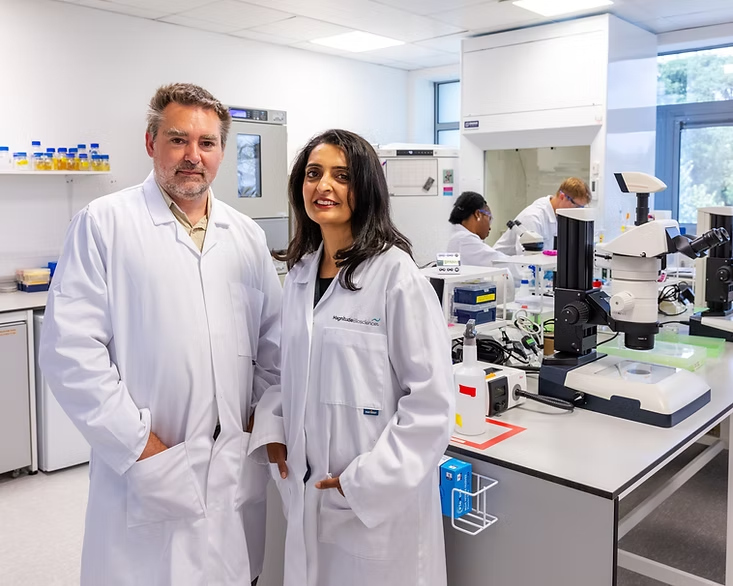
Magnitude Biosciences: How a Durham spinout is driving health innovation and regional growth

Magnitude Biosciences: How a Durham spinout is driving health innovation and regional growth (Image : Russell Group)

When Durham University researchers Dr David Weinkove and physicist Dr Christopher Saunter launched Magnitude Biosciences in 2018, they did so with a clear ambition: to transform how the UK accelerates drug discovery.

Just a few years later, their company is proof of the benefits that research-intensive universities can help innovators deliver — not only for science, but for public health, the NHS and regional economies.

Magnitude Biosciences is a specialist contract research organisation based at NETPark in County Durham, where its team uses tiny Caenorhabditis elegans worms – organisms with neurons, skin, gut, muscles and other tissues similar in genetics to those in humans – to rapidly test the effects of different compounds on ageing, neurodegeneration and overall health. NETPark is a Durham County Council site, managed by the local authority’s business support service, Business Durham.


Filed Under: Education, home_page, News, News Headline

March 25, 2026 by Lisa Cartwright

Durham University secures best-ever 22 subjects in world top 100 in QS World University Rankings by Subject 2026

A group of students outside of the University

Durham University has achieved a best-ever 22 subjects in the world top 100 in the QS World University Rankings by Subject 2026.

Durham’s previous best result, achieved last year, was 21 subjects in the elite world top 100. This year’s record return includes three subjects in the world top 10, and 10 in the world top 50.

Four ‘broad subject’ areas and 17 ‘narrow subjects’ have improved their QS rankings from last year, demonstrating Durham’s excellence across a wide range of subjects.

Durham’s highest ranked subject is Theology, Divinity and Religious Studies, where it is ranked fourth globally. Durham’s Department of Theology and Religion is one of the largest in the UK and brings together a vibrant international community of scholars and students.

Archaeology at Durham is ranked fifth in the world, reflecting the University’s internationally recognised research in areas including world prehistory, early complex societies, Roman and Classical archaeology, South Asia and Eurasia, and historical and contemporary archaeology. Durham’s recent archaeology research includes major discoveries, from the Iron Age ‘Melsonby Hoard’ to a newly uncovered Roman-era industrial hub near Sunderland.

In Geography, Durham has moved up five places to sixth in the world, highlighting its world-leading community of geographers conducting innovative and impactful research to transform lives and make a difference both globally and locally.

Law at Durham has entered the world top 50, ranking joint 49th.

The following subjects at Durham are placed in the global top 50: Anthropology (joint 25th), English Language and Literature (26th), Classics and Ancient History (joint 29th), Philosophy (joint 39th), Modern Languages (joint 40th), History (44th), and Law (joint 49th).

At the broader subject level, Durham continues to perform particularly strongly in the arts and humanities. In the 2026 rankings, Durham is placed joint 31st globally, reinforcing its status as one of the world’s leading institutions in this area. The University is also ranked joint 78th globally for Social Sciences and Management, reflecting the strength of programmes in law, education, politics, and related disciplines.

In science, Psychology moved up to 70th and Physics and Astronomy to joint 67th. Mathematics, Computer Science and Information Systems, Engineering and Technology also enhanced their rankings, and the broad subject area of Natural Sciences entered the world top 100.

Durham is consistently ranked as one of the world’s leading universities. It is The Times and The Sunday Times Good University Guide University of the Year 2026. It is ranked 94th in the QS World University Rankings 2026, and fifth in the Guardian University Guide 2026 and Complete University Guide 2026. Durham University Business School is among an elite group of business schools worldwide to be accredited by AACSB, AMBA and EFMD/EQUIS.

Professor Karen O’Brien, Vice-Chancellor of Durham University, said: “Durham is a world-leading university. The outstanding nature of our teaching and research is reflected in our global rankings success.

“It is particularly pleasing to see a high volume and broad range of subjects again placed so highly in these most prestigious rankings.

“We have been a world top 100 university every year since 2010. We are The Times and The Sunday Times UK University of the Year 2026.”

The QS World University Rankings by Subject are among the most prestigious global rankings, assessing universities using indicators including academic reputation, employer reputation, research citations, and international research collaboration.

The 2026 rankings analysed more than 6,200 institutions worldwide, with 1,900 universities ranked across 55 subjects, producing over 21,000 individual ranking entries.

Full rankings are published here.

Filed Under: Education, home_page, News, News Headline

November 28, 2025 by Lisa Cartwright

Leading the way in groundbreaking research

A scientist in a lab

Durham University have been ranked third in the UK for interdisciplinary science research.

Our researchers work across traditional academic disciplines to address global challenges, transforming lives for the better.

That’s why we’re very pleased to have been placed third in the UK, and 128th globally, in the second annual Times Higher Education Interdisciplinary Science Rankings.

Interdisciplinary research at Durham

The heart of interdisciplinary research at Durham is our 10 research institutes, where academics from often very different backgrounds are encouraged to collaborate, share ideas and approaches, and find innovative solutions.

Much of our interdisciplinary research focuses on the United Nations Sustainable Development Goals (SDGs) – 17 goals to create a better world by 2030, from ending poverty to addressing climate change.

We rank 24th in the QS Sustainability Rankings 2026. Recently, seven of our staff and students travelled to COP (Conference of Parties) 30, the recent global climate conference in Brazil.

Earlier this year, we launched the Leverhulme Centre for Algorithmic Life, which brings together experts from across the sciences, social sciences, and humanities to explore how artificial intelligence (AI) and machine learning are transforming society. This is led by Professor Louise Amoore, from our Department of Geography.

Earlier this month, six of our researchers, five from our Department of Physics and one from our Department of Engineering, were named in the 2025 Clarivate Highly Cited Researchers list.

A world top 100 university

Our ranking of third in the UK for interdisciplinary science adds to our status as a world top 100 university, and The Times and The Sunday Times UK University of the Year 2026. We have a best-ever 21 subjects in the world top 100 in the QS World University Rankings by Subject 2025, and we are in the top five for all three major UK university rankings.

Filed Under: Education, home_page, News, News Headline

  • Page 1
  • Page 2
  • Go to Next Page »

Footer

Durham-UK

  • TOGETHER FOR DURHAM
  • WHY DURHAM
  • DURHAM CHAMPIONS
  • NEWS
  • NEWSLETTER SIGN UP
  • TOOLKIT
  • CONTACT US

In partnership with:

Durham County Council logoDurham University logoBusiness Durham logoVisit County Durham logo

#ourdurhamstory

Durham County Council logo

© Durham-UK

Legal Information | Accessibility statement